Nigel Wakeham
ARCHITECTURAL CONSULTANT

Projects In Myanmar

Revitalisation of the University of Rangoon
Myanmar
The Assignment
In 2014, I was asked to join a mission which was to develop a vision for the revitalisation of the University of Rangoon in what is now known as Myanmar, previously Burma. The mission was funded by the Australian government whose Department of Foreign Affairs and Trade (DFAT) had been providing technical assistance to support the development of higher education in Myanmar and this mission was a continuation of that assistance.
By the time of the mission, a committee, chaired by Daw Aung San Suu Kyi, had been established in the country’s parliament for the Revitalisation of Rangoon University. The objective of the assignment was to provide a comprehensive series of recommendations and next steps for the committee and for the university management, in terms of the governance and management of the university, educational quality and infrastructure.
The assignment was to be undertaken by a team of experts, headed by an eminent higher education expert who would provide overall leadership of the review assisted by a technical leader who would ensure the delivery of high quality outputs and an infrastructure advisor (which was my role) who would provide advice on the condition and development of the physical infrastructure of the university.
A Brief History of the University Buildings
Rangoon University was incorporated in 1920 under the University of Rangoon Act. It was largely autonomous with academic responsibilities resting with the Senate and the Supreme Governing Body taking ultimate responsibility for the University. The University initially comprised two Colleges with a significant estate of 400 acres (162 hectares) which was purchased for 1.2m pounds.
Rangoon College had been established in 1878 by the British colonial government and was an affiliated college of the University of Calcutta until it became part of the University. It was re-named Government College in 1904 and University College in 1920. A Baptist-affiliated college, Judson College had been established on the same site in 1894 and initially was also affiliated to the University of Calcutta.
The original buildings constructed in the 1920s were:
-
Convocation Hall.
-
Judson College (which consisted of what then were the Arts Hall building and the SEAMEO Regional Centre for History and Religion).
-
Judson Church.
-
University College (which was then the Science Hall).
-
University Library (which was a gift from a wealthy Indian merchant)
-
Male and female student dormitories.
-
University Student Union Building (demolished in 1962).
-
Senior and junior staff houses.
-
Various other facilities
Mandalay College was added in 1925 and a Teachers Training College and a Medical College were added in 1930 and by the early 1930s the three colleges located on the estate provided accommodation for 1,400 male and 350 female students.
By 1930 the University campus contained three colleges:
-
University College which offered degrees in Science, Engineering, Forestry and Law
-
Judson College which offered degrees in Arts and Science
-
Teacher Training College which offered degrees and certificates in Education
The University was essentially residential and centralised and the estate accommodated a self-contained university town with teaching and residential buildings (for students and staff); a hospital; a post office; a telephone exchange; a book shop; a servant’s village with a village school and a clerk’s village. There were also extensive recreation grounds for students and staff and the estate had its own roads, water, electricity and sewage disposal services.
The estate was divided into two sections by what was then called Victoria Road (now known as University Avenue Road). The smaller section to the north (what is now known as the University of Yangon campus) contained Convocation Hall, the University Library, University College, Judson College, staff and student accommodation, a gymnasium and squash court, the Baptist Church, Judson College playing fields and the Student Union building. The southern section of the estate which was almost twice the size of the northern section contained the post office, the hospital, the teachers training college, the engineering college, the servant’s village and clerks’ quarters, staff and student accommodation and extensive recreation grounds. The latter included a swimming and rowing club, a football ground, hockey fields, cricket pitches, running tracks, 50 tennis courts, squash courts, a gymnasium which converted into a theatre and a student union.
See here for a 1933 publication which shows the original buildings and layout.
The University modelled itself on Oxford and Cambridge Universities with residential colleges which provided accommodation predominantly for male students but also for female students. It soon became one of the premier universities in the South Asia region attracting students from across the country and the region and was ethnically diverse. Tuition was in English and standards, which were assured through examination from Britain, were high. Before Independence, the University produced world famous students such as General Aung San, the founder of the Union of Burma who attended the University between 1933-1938 and U Thant, who became Secretary General of the UN from 1961-1971.
Burma became independent In 1948 and the following year the Government turned its relatively autonomous colleges into faculties of the University. In 1959, the University of Mandalay was established as a separate university, with its own system of affiliated colleges.
Campus Design
During the mission, I was led to understand that the original buildings were designed by colonial architects from the University of Calcutta but recently, Dr Patrick Zamarian of Liverpool School of Architecture, has told me that he believes they were designed by an English architect, Thomas Foster, who was based in Burma.
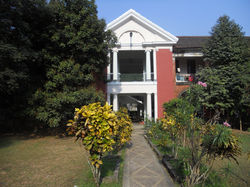
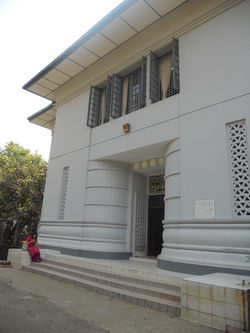
The University is a remarkable example of a fully designed colonial period integrated campus. The buildings were designed in a stripped-down neo-classical style with Indian influences and were in the main, well designed for the climate with very high ceilings, thick walls and single-banked rooms that allowed for the maximum cross-ventilation. The buildings were arranged with lots of green space between and the northern section had a strong central axis centred on the Convocation Hall. Further buildings were added in a similar style during the 1950s and other buildings were added in more modern styles during the 1980s. The southern, larger section of the estate was lost to the university when a number of departments and faculties were separated from it in 1962 and the area of the campus was approximately one third of the original area of 400 acres.
The University campus was and continues to be a site of both national and international significance: physically because the original buildings and the spaces between them are largely intact; culturally because of the importance of the campus in the development of anti-colonial and national politics; and educationally because of the importance of the University both nationally and regionally.
Campus Condition
At the time of the mission, the buildings, the infrastructure and the campus generally were in very poor condition having been neglected for many years. The buildings were very run down with roof leaks, floors that were breaking up, doors and windows that needed repair, sanitary facilities that required complete renovation and for the most part very unsuitable furniture. Facilities such as laboratories and computer rooms were not fit for purpose and new specialised accommodation was required and even the general teaching spaces required major renovations and updating. The water tanks and water reticulation around the campus were very old with many leaks and required major repairs or replacement and the electrical reticulation was also badly in need of upgrading and/or replacement. The campus landscaping had been neglected for many years and footpaths had collapsed or disappeared, storm-drains had filled up with soil and vegetation and no longer functioned and trees and shrubs had been allowed to grow rampant, many of them much too close to buildings where they would eventually cause structural damage.
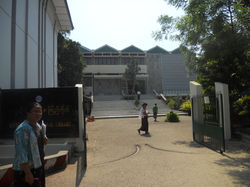
See here for a more detailed assessment of the existing buildings and campus at the time of the mission and see photos of the buildings as they existed during the mission in the photo gallery below.
Recommendations
My assessment of the situation at the University and my main recommendations at the time are summarised below.
‘There seems to be a general desire to bring the university, the campus and its buildings back to something like their former glory and to re-establish the university as one of the premier universities of the region. To do this will require a great deal of expenditure on both renovating the existing buildings and campus and on constructing the new buildings that will be required for a 21st century university.
Part of the university’s vision for its development must be for the development of the buildings and infrastructure of the university whether on the existing campus alone or on that and other satellite campuses. The vision for the buildings and infrastructure must be developed in tandem with the development of the academic vision in order that they enhance and do not obstruct the future development of the university.
Methods of teaching and learning are changing fast and the university has the opportunity to avoid many of the problems encountered by other universities both in the region and around the world in their physical development during the second half of the 20th century: that is the badly planned campuses and inappropriate and inflexible buildings that are now restricting their further development in the age of the internet which will require different methods of teaching and learning and different more flexible types of buildings.
The design of the new facilities should reflect the university’s vision and strategy for teaching and learning and be responsive, inclusive and supportive of attainment by all. The design and management strategy for renovating and re-using the existing buildings and providing new facilities must therefore be well co-ordinated and complimentary to the academic strategy.
There are a number of ways that the university could develop depending upon the vision for the future of the university that is adopted, the number of subjects and students to be taught and the speed at which technology changes teaching and learning patterns. One scenario would see much of the various syllabi being taught on-line with students coming on to the campus only for seminars and tutorials with staff and informal learning and socialising with other students. The need for buildings would then be much reduced. Another scenario would see satellite campuses being established for specialised subjects such as science and technology which cannot be easily accommodated within the existing buildings. The existing campus would remain the central hub of the university with quick and efficient ‘green’ links to the satellite campuses and there would be a strong case for the university to reclaim at least part or parts of the original campus that were taken away in the 1960s.’
My detailed recommendations (Infrastructure: Visions of the Future; Developing a Strategic Plan and the Concept of Cultural Significance) that were contained in our report can be seen here.
Afterword
We submitted our report to both the Committee for the Revitalisation of Rangoon University and to DFAT but unfortunately our recommendations were not followed through, probably due to financial restraints.
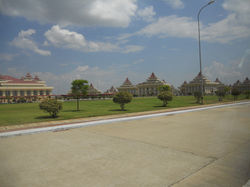
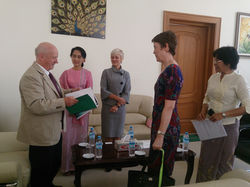
We also met with and presented our report to Daur Aung San Suu Kyi in her office in one of the parliament buildings in the new capital of Naypyidaw, designed and built by the Chinese Government. The new parliament is an extraordinary collection of buildings approached via a ten-lane motorway and surrounded by a moat with access via a few bridges so that the whole of parliament can be isolated very easily in times of civil unrest! See photos of the parliament buildings and our meeting here.
Since our mission, the ethnic strife and the civil war that was ongoing even then have continued and after the 2020 election in which Aung San Suu Kyi’s party won a clear majority, the army again seized power in 2021, Aung San Suu Kyi is back in detention and the country is again ruled by a military junta.
While I was in Myanmar, I met Dr Nicholas Warner who had been asked by the Turquoise Mountain Foundation to carry out a survey of Bago Hall, one of the most important buildings on the university campus as it contains the room occupied by Aung San Suu Kyi’s father, Aung San when he attended the university. Aung San negotiated the Panglong Agreement with ethnic leaders that guaranteed the independence of Burma as a unified state but he was assassinated before the country achieved independence.
Dr Warner’s report is very detailed and contains proposals for renovating the building and a copy can be seen here.
Existing Campus Gallery
 |  |  |
|---|---|---|
 |  |  |
 |  |  |
 |  |  |
 |  |  |
 |  |  |
 |  |  |
 |  |  |
 |  |  |
 |  |  |
 |  |  |
 |  |  |
Parliament & Aan San Suu Kyi
 |  |  |
|---|---|---|
 |  |  |
 |  |  |
 |
